Asbestos Sand Toy Recalls: More than 30 Toys Recalled Over Asbestos-Contamination Fears
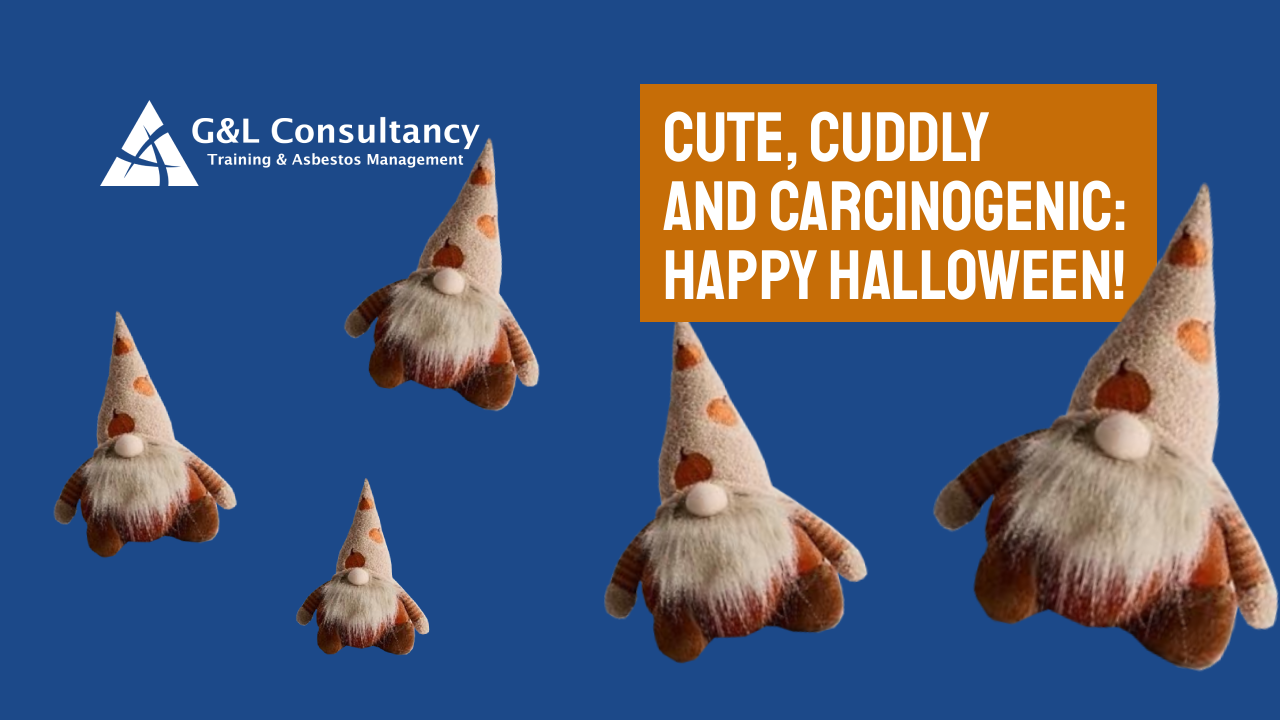
More than 30 toys recalled over asbestos contamination fears in 2026. Why is this still happening?
A G&L Consultancy Ltd employee provides some insight into the recent wave of product recalls in the UK relating to concerns over asbestos contamination, most recently the recall of children’s Primark Halloween gonk decorations containing sand that may be contaminated with asbestos.
The Obvious Question Is: How Does This Keep Happening?
In Great Britain, the use and supply of asbestos was prohibited by 1999. Historically, however, asbestos was used extensively, particularly within the construction industry, because it was cheap, durable, strong and had excellent fire-resistant properties. Following the Second World War, it became particularly useful in the rapid construction and repair of buildings, with asbestos-cement products such as corrugated roofing sheets being relatively straightforward to manufacture and install.
It is also important to remember that the dangers of asbestos were not completely unknown. There had been recognition of the health risks associated with asbestos exposure for many decades, yet its useful properties and relatively low cost meant that it continued to be widely used.
Today, the UK has stringent legislation controlling asbestos, and there is no legitimate reason for asbestos to be intentionally incorporated into consumer products. The problem we are now seeing is rather different: products manufactured overseas can enter the UK supply chain containing naturally occurring asbestos contamination that has not been identified or adequately controlled.
This Is Where Things Become More Complicated
A UK company looking for a competitively priced product may source it from overseas, where the raw materials, manufacturing processes and regulatory controls can be very different from those in the UK. The finished product may look completely harmless – a children’s toy, craft kit, decorative item or Halloween decoration – but if the raw material used during manufacture have not been appropriately assessed, there is the potential for contamination to make its way into the finished product.
This does not necessarily mean that a manufacturer has deliberately used asbestos. In many of the recent cases, the concern relates to naturally occurring asbestos within mineral materials such as sand.
Asbestos itself is a naturally occurring mineral. It is not something that is manufactured in the conventional sense; rather, asbestos minerals occur naturally within geological formations. Because of this, other minerals and materials extracted from the ground can potentially become contaminated depending on where and how they are sourced and processed. This is why understanding the provenance of raw materials is so important.
There is an interesting comparison here with the long-standing concerns around asbestos contamination in talc.
Talc is also a naturally occurring mineral, and certain talc deposits can occur alongside asbestos-bearing minerals. Historically, this has resulted in significant concern and litigation surrounding asbestos contamination in talc-containing products. Modern processing and quality-control procedures have significantly reduced the likelihood of asbestos being present in properly controlled talc products, although the subject remains controversial and highly scrutinised.
The recent recalls of sand-containing products raise a similar question about how well mineral-based raw materials are being controlled further up the supply chain.
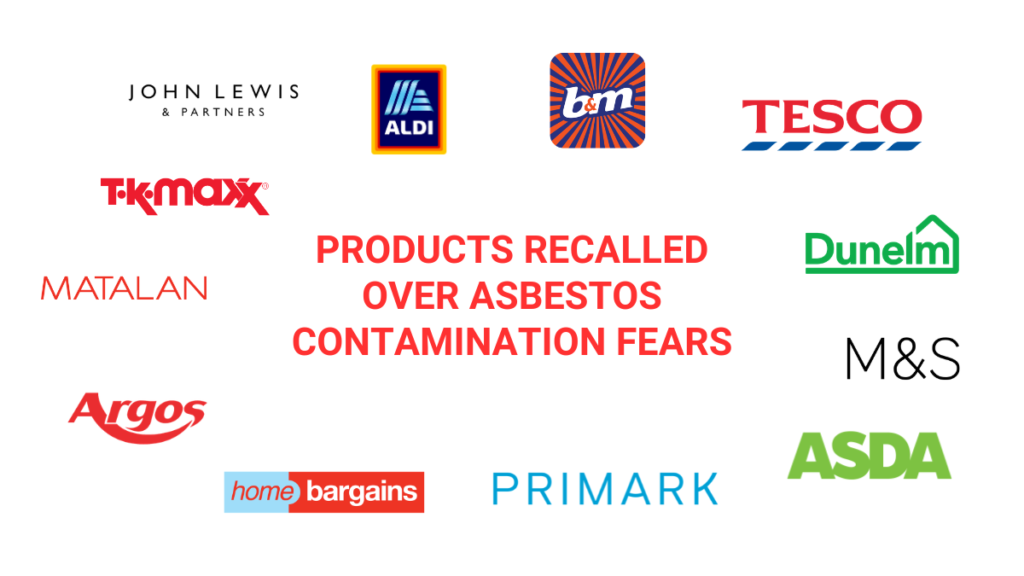
The issue is not necessarily the sand itself. Sand is used in an enormous number of perfectly safe products. The concern is whether the source material has been appropriately assessed, processed and tested to demonstrate that it is free from asbestos contamination before it is incorporated into a consumer product.
The scale of the recent recalls is also worth considering. According to figures provided to Parliament in September 2026, 69 asbestos-contaminated consumer products have been recalled since 2021, including 36 toys. Remarkably, all 36 of those toy recalls occurred during 2026.
That suggests this is not simply a one-off issue involving a particular Halloween decoration or an isolated manufacturer. There appears to be a wider issue around mineral-based materials entering consumer-product supply chains without sufficient assurance that they are free from asbestos contamination.
And It Probably Won’t Stop at Halloween
The same types of products can be manufactured in the same facilities, using the same raw materials, and then marketed for completely different seasons or purposes. A Halloween gonk today could potentially be a Christmas decoration tomorrow, using the same or similar sand-filled construction. That does not mean that Christmas decorations are contaminated, but it does demonstrate why understanding the wider supply chain is so important.
For consumers, this can be particularly difficult to navigate. A product may be perfectly ordinary in appearance and there is no obvious way for someone standing in a shop to know where the sand, mineral or other raw material originated.
For Businesses, However, There Is a Greater Responsibility
UK companies importing products cannot simply assume that because something has been manufactured overseas, it has been produced to the same standards that would apply if it were manufactured here. The responsibility for product safety ultimately sits with the businesses placing products on the UK market, and that means understanding the supply chain and having appropriate controls in place.
Testing finished products is clearly important, but it should not be the only line of defence. Businesses should be asking where raw materials come from, how they are processed, what controls the manufacturer has in place and whether there is appropriate evidence to demonstrate that the materials being used are safe.
We have seen the consequences of getting asbestos control wrong before. The UK spent decades dealing with the legacy of asbestos in buildings, despite the health risks being recognised long before the material was eventually prohibited.
We should not now be creating a new legacy through poorly controlled imported consumer products.
So, Where Do We Go from Here?
As a consumer, there is no need to panic or assume that every sand-filled toy or decoration is dangerous. However, it is sensible to pay attention to product recalls and to check the official guidance if you have purchased one of the affected products.
For businesses, the message is perhaps more straightforward: know what is in your products, know where your raw materials come from and, importantly, know what controls your suppliers have in place.
The current recalls should be a reminder that product safety does not begin when a finished product reaches the warehouse or the shop shelf. It begins much further back, with the raw materials and the supply chain behind it.
If you’re interested in learning more about asbestos, you can join our Asbestos Awareness course which we run in-person or online: https://gnl-consultancy.co.uk/product/asbestos-awareness/
If you need advice or support with asbestos management G&L Consultancy offers asbestos surveys, testing, removal, management services, training, and respirator face fit testing across the UK and Ireland. Find out more on our website: https://gnl-consultancy.co.uk